
The future of JNE - best results ever and we’re ready for more!
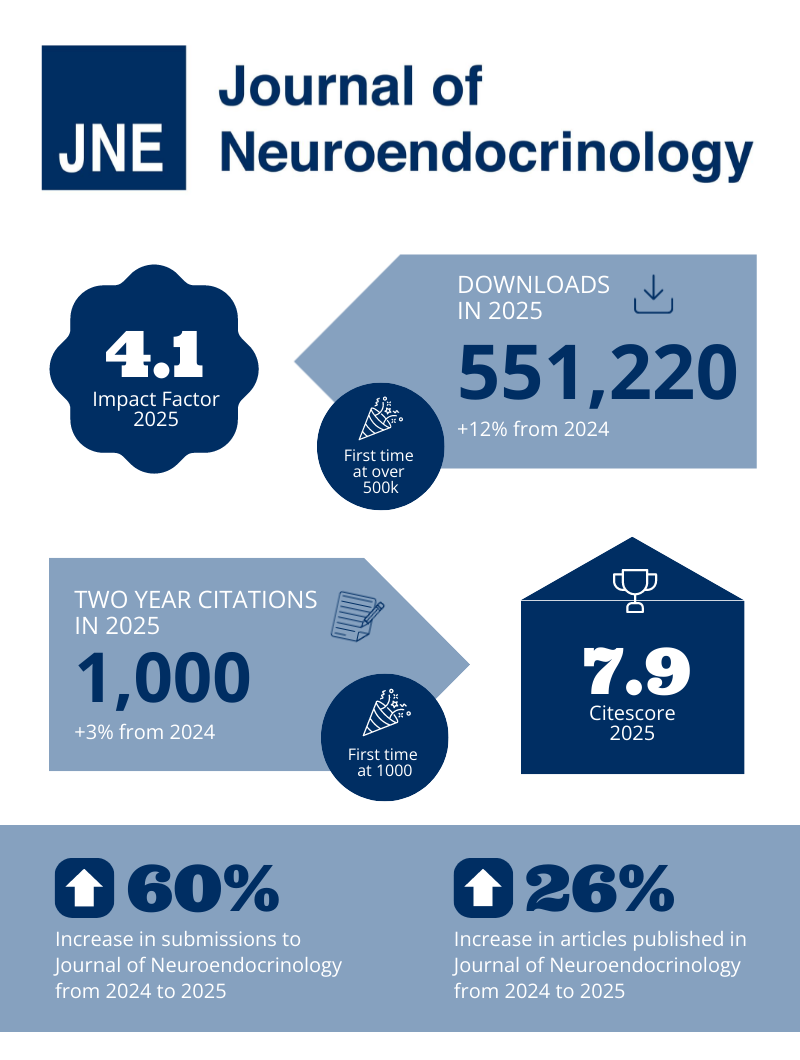
The JNE editorial team are very proud that our journal is now recognised as the leading journal in our field, with an Impact Factor of 4.1, ahead of many other key journals (including Endocrinology, Journal of Endocrinology, and Journal of Neuroscience), and a Citescore of 7.9. This is the result of years of strategic planning, with editors, past and present, working with Wiley, the British Society for Neuroendocrinology (BSN) Committee and BSN staff. In 2017, we set a target of 4 for the 2024 Impact Factor and – bingo! – we exceeded it. Two-year citations topped 1000 for the first time (968 in 2024; 858 in 2023). The 2025 online usage also set a record, with full text downloads exceeding 500k for the first time, reaching 552k (493k in 2024; 417k in 2023). Submissions increased by a huge 60% in 2025, and articles published by 26%. All of this is very rewarding for those of us who have been working hard on JNE for a number of years. The financial results are also keeping pace, which is far from what many societies are experiencing.
But this is only the start. The Editors-in-Chief (Mike Lehman and deputy Bob Goodman for the Fundamental and Mechanistic (FMN) strand, and Wouter de Herder and deputy Kristi Alexandraki for the Translational and Clinical (TCN) strand) are developing the journal even further, continuing the meeting-derived Special Issues (SIs), but also commissioning SIs on a range of important topics (see separate article).
JNE is also extending its geographical reach. Our links with PANS are improving our connections in central and south America. Mike and Bob spent a week in India in 2024, working on a Pan Indian workshop on neuroendocrinology, and we believe an Indian Neuroendocrine Society may soon be established. We also published an SI from the quadrennial International Conference on Avian Endocrinology, which was held in India in 2024. We intend to have a focus on China and Korea next year.
Last, but certainly not least, we mustn’t forget that JNE provides almost all the income for the BSN to support neuroendocrinology around the world, whether by grants to scientists, support of meetings, career development opportunities, or the range of other activities. Many societies are seeing their journal income – and thus their overall income – gradually reduce, but BSN is currently holding steady and in fact growing in income, thanks to JNE!
All in all, an exciting time to be involved with JNE.
Sue Thorn
CEO, British Society for Neuroendocrinology
Infographic data source: Wiley Insights