
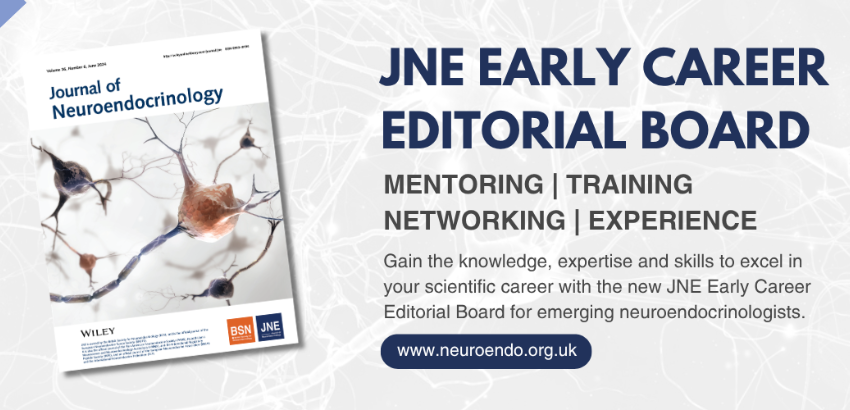
Applications to join JNE Early Career Editorial Board are open
The Journal of Neuroendocrinology (JNE) is delighted to announce applications are open for its Early Career Editorial Board.
As part of its commitment to neuroendocrinology and the support of early career researchers (ECRs) in the field across the world, and in light of a successful initial run, the Journal of Neuroendocrinology (JNE) is seeking highly motivated individuals to appoint as the second cohort of its Early Career Editorial Board. This programme provides ECRs from diverse backgrounds with the opportunity to receive mentoring on the editorial process and hands-on experience in peer review and editorial practices from senior editors at JNE as well as access to career development workshops on topics in scholarly publishing and peer review.
Twenty ECRs will be selected, with appointments made for two years starting January 2027. Depending on their background and interests, Early Career Editorial Board members have the option of working with mentors from either the Fundamental and Mechanistic (FMN) or the Translational and Clinical (TCN) strands, as well as the respective Editors-in-Chief (EiCs) and Deputy EiCs for each strand. The deadline is 15 November 2026.
The JNE Early Career Editorial Board will empower emerging neuroendocrinologists with knowledge, expertise and skills related to science publishing and peer review to excel in their scientific career.
"The ECR Editorial Board programme has strengthened my ability to write and respond to reviews, improved the quality of my own manuscripts, and expanded my professional network within the field. Perhaps most importantly, it has given me a sense of belonging in the scientific community." - Dr Isadora Clivatti Furigo
Benefits for early career researchers
- Receive access to comprehensive online training on peer review and the editorial process through structured workshops and experiential learning through shadowing a senior editor from your area of research expertise.
- Receive mentoring from an expert aligned to your area(s) of research interest within neuroendocrinology.
- Opportunity to provide feedback on the content published in the journal, and suggest special issues, commentaries, and topical reviews.
- Networking with peers on the ECR editorial board and mentors from the JNE senior editorial board.
"Through this program, I have had a sneak-peak of the whole process from the authors’, reviewers’ and editors’ point of view, and I am utilising these skills and knowledge in my career as faculty, specifically on how I advise my colleagues, mentees and students." - Dr Stephen Manchishi
Structure
- Up to 20 ECRs will be appointed.
- Term of appointment will be for 2 years.
- Depending on their background and interests, ECR editorial board members have the option of working with mentors from either the Fundamental and Mechanistic (FMN) or the Translational and Clinical (TCN) strands, as well as the respective Editors-in-Chief (EiCs) and Deputy EiCs for each strand.
"One of the most useful aspects of the programme was the opportunity to compare my own reviewing style with those of other reviewers and editors. Seeing how others assess manuscripts and provide feedback helped me reflect on my own reviews and consider how I can make my comments more constructive and useful to authors." - Dr Theodora Georgescu
ECR roles and responsibilities
- Commit to attending training and professional development workshops associated with editorial processes, including peer review, ethics, rigor and reproducibility, data sharing, and hot topics in science publishing such as use of generative AI.
- Working together with your senior editor mentor, contribute timely and constructive peer-review of articles submitted for publication to the JNE (up to a maximum of 6 papers per year).
- Attend virtual editorial board meetings and an annual in-person meeting if feasible.
- Provide feedback to the JNE leadership and represent the needs of the ECRs in the development of the journal.
- Serve as advocates for JNE and its role as a society-based journal in the community.
Eligibility requirements
- ECRs working in neuroendocrinology within 10-years of award of PhD, DVM or MD (or equivalent clinical qualifications).
- Exceptions can be made for career breaks (including COVID-associated disruptions).
- When an individual has more than one doctoral degree, the date of completion of the first will count towards the qualification period.
- A current member of one of the following learned societies that has JNE as its official journal:
- British Society for Neuroendocrinology (BSN)
- Pan American Neuroendocrine Society (PANS)
- Hypothalamic Neuroscience and Neuroendocrinology Australasia (HNNA)
- International Regulatory Peptide Society (IRPS)
- European Neuroendocrine Tumour Society (ENETS)
- European Neuroendocrine Association (ENEA)
- Société de Neuroendocrinologie (SNE)
- Must not have previously served on an editorial board at another journal.
- ECRs from historically excluded and/or under-represented populations are particularly encouraged to apply.
- ECRs from across the globe are welcomed.
Application materials
- Brief CV
- Confirmation of membership in one of the named learned societies.
- Letter from current supervisor or head/chair of department/unit providing confirmation of support/protected time.
- Please upload a covering letter/expression of interest (max. two A4 pages) which includes:
- Your motivation and commitment to the role.
- Your engagement with the neuroendocrinology community via the learned society to which you belong (see list above).
APPLY VIA THE APPLICATION FORM
Deadline: 15 November 2026
Selection criteria
- Personal/career developments benefits to ECR.
- Evidence of motivation and commitment to the field of neuroendocrinology.
- Where possible a balance of demographics (sex/gender, research areas, geographic location and ethnicity) will be sought.
- Scoring of applications will be performed by the EIC, deputy-EIC and a selected panel of senior editors.
Timeline
Applications open: 1 September 2026
Applications close: 15 November 2026
Applicants will be informed of the outcome: 18 December 2026
Appointments start: 1 January 2027